Tuesday, November 27, 2007

"Forget it Jake, it's Chinatown ... Now, where was I?"


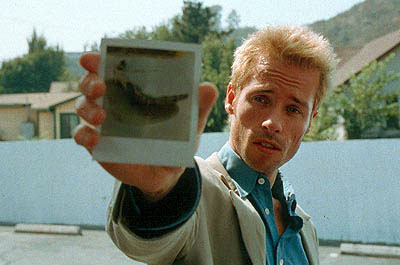
No matter which neo-noir you watched, Chinatown or Memento, you were treated to some shocking revelations near the end of the film that made you reevaluate everything that came before them. They also helped elevate their respective films from the thriller/crime genre into something harder to put your finger on -- both films transcend the fates of their protagonists and leave you (or should leave you) unsettled about the awful capabilities of human nature.

All of this is to say that thinking and writing about the larger implications of your film's mysteries might be one way to approach your last blog post on film noir. If you watched Memento, you might want to check out this site, which could shed some light on a few questions you have about the film. And as always, here are other possibilities:

o Discuss/analyze an important scene
o Expand on a discussion question from class, whether from a film or a reading
o Make a connection to the real world/current events
o Discuss/analyze an aspect of cinematic style important to the film
o Discuss/analyze a topic or theme important to the film
o Relate it to another film, either from class or personal viewing
o Discuss ideas for future viewing inspired by film

Note that none of these bullet-points includes saying that you really, really liked or disliked the movie and why (that's what the polls at the top of the page are for). It's not that I don't care whether or not you liked it, but I'm far more interested in your analysis and interpretation than a cursory opinion.

Thursday, November 15, 2007

"I fell in to a burning box of fire ... "

If you're looking for ideas on what to write about Kiss Me Deadly, here's an idea: do a little research on one of the allusions that Dr. G.E. Soberin made -- he had quite a few, even one when he was dying of a gunshot wound -- and discuss the relevance of the allusion to the film. Here are the main ones I can think of: Pandora, Lot's wife, Medusa, Cerberus. Feel free to write about another one that you remember.

Or, if you want to continue to discuss the apocalyptic ending, here's a link to an excellent article about possible reasons why there are two different endings and the writer's (excellent film/DVD critic Glenn Erickson) interpretation of them. Neither of them look like this, the ending of Mickey Spillane's novel on which the film is based:
In the novel Hammer finally catches up with femme fatale Lily Carver just after she's taken an alcohol rubdown. He offhandedly ignites her with a Zippo. She burns in agony. He takes calm satisfaction from his deed. It's sort of a followup to outdo the sadistic I the Jury ending. There Hammer shoots a wrong dame in the stomach with the quip, "It was easy."
So, yes, it's actually possible for Mike Hammer to have been more sadistic than he was in this movie.

Lastly, just because I want to prove to you that this movie is regarded as a classic, and that I didn't choose it by throwing darts at a noir dartboard, here's a link to an essay by noted film noir scholar (yes, such people exist) Alain Silver that analyzes KMD's stylistic hallmarks. I don't expect you to read the whole thing, but at least glance at a few paragraphs.

Thursday, November 8, 2007

"Ass-kicked by fate"

That's one of the great quotes -- in this case, about the noir protagonist -- from this primer on film noir, which is written by noted noir expert Eddie Muller. I love his examples in answering the question of whether noir is a genre or a style, and he also talks about whether or not noir is made today.

Speaking of which, for you Sin City fans, here's an excellent site that comes to the conclusion that this movie might be the quintessential film noir. If you're a fan of the movie, you need to read it.

Monday, November 5, 2007

The Groundhog is Jesus

Or so says a film critic in this article from The New York Times on the surprising popularity of Groundhog Day among religious scholars.

Michael Bronski, a film critic for The Forward who teaches a course in Jewish film history at Dartmouth, said he sees strong elements of not only Jewish but also Christian theology. "The groundhog is clearly the resurrected Christ, the ever hopeful renewal of life at springtime, at a time of pagan-Christian holidays," he said, adding: "And when I say that the groundhog is Jesus, I say that with great respect."

But before you dismiss the whole article as claptrap, you should read it and see how neatly the message of the film (the way the scholars interpret the message, anyway) fits into the beliefs of so many different faiths. Maybe it says more about the similarities of the world religions than it does about the movie, but it's still an interesting read. It would be fantabulous if you worked a reaction to this article into your post (4th and 6th hour students, that is).

Monday, October 29, 2007

Don't be that guy (or girl)

Warning: sermon ahead ...

A lot of people liked Unforgiven or Once Upon a Time in the West much more than Stagecoach or My Darling Clementine. That's cool -- as much as I love Clementine, I'd probably pick those two over it as well. But a lot of people listed this as one of the reasons they preferred the revisionist Westerns to the classics: they were in color.

This is not cool.

Now, your taste is your taste, and obviously, you're entitled to like or not like whatever you want. But I implore you to judge films not by how old they are or if they're in black and white or color, but by how well they do their job. For example, Citizen Kane is utterly unthinkable in color. Remember all that low-key lighting with pockets of deep shadows? If Orson Welles and his cinematographer Gregg Toland photographed those scenes in color they would've completely altered that effect. So am I saying black-and-white is superior to color? Of course not. If Citizen Kane were photographed in color (and yes, color film stock was around in 1941, though it was much more expensive than black and white), Welles and Toland would've made different choices regarding their lighting, and who knows, they could've come up with images every bit as stunning. To dislike Citizen Kane because you thought that the photography was over-the-top, distracting, show-offy, etc., is a valid argument. But people who say they dislike Citizen Kane because it's in black and white say a lot more about themselves than they do about the film.

It's a form of reverse snobbery, if you will -- how would you feel if I said old movies were inherently superior to movies of today? You'd say I was a jackass, and you'd be right -- like any art form, most of what gets produced during any era of cinematic history is going to be disposable, including the '30s and '40s, the golden age of Hollywood.

Anyway, I came across the following in The Onion A.V. Club, the arts and entertainment section of our nation's finest satrical newspaper. They have this feature called "Ask the A.V. Club," where readers write in to have their questions answered by the A.V. Club staff. Please read it, paying special attention to the last paragraph, and feel free to leave your comments below. I will now dismount my soapbox.

Not Hooked On Classics

I am a huge movie fan, having seen pretty much all the greats from the '70s on. However, I felt my knowledge was lacking from having not seen many of the consensus greats from the '60s on back. Working from several top-100 lists by reviewers I like, I began watching these oldies, and found they weren't so great. I found The Big Sleep to be a huge letdown, with Bogey's hammy line readings and an uninspired story. I understand why Citizen Kane is considered great, but I had to hear the commentary to really appreciate it. It is not until the French New Wave of the '60s that I find films I really dig. I wonder: Do these old films seem mediocre because I'm seeing them after witnessing the films they inspired? Was acting in the '40s and '50s not real enough? Am I the only one who thinks that these films, while great at the time, should be looked at as historical sources of modern cinema and not placed above far superior modern films?

Brian P. Adams

A mortified Noel Murray replies:

First off, when you refer to "far superior modern films," you do realize that you're talking about a matter of taste, right? There's very little that's quantitative about evaluating movies. For example, naturalistic acting is just fine, but it's far from the only effective mode, even in 2007. Christopher Walken is about as natural as high fructose corn syrup, but when he's on the screen, it's hard to look away from him—even in bad movies. Similarly, no one kind of storytelling is superior to another. In fact, sometimes "storytelling" is the last thing on a filmmaker's mind. Just read interviews with the late Robert Altman, who considered his films' stories secondary to their record of human behavior. Or hold a séance and consult with the creators of The Big Sleep, who were more interested in rat-a-tat dialogue and abstracted tough-guy posturing than in revealing who killed who and why.

It's not that the classics are unassailable, by any means. They can be problematic thematically, too clunky in the staging, and, yes, the acting can be distractingly broad. But when seen in the context of the other films from their era, the reasons why they're considered great—and not just "great for the '30s"—become plainer. Once you get used to some of the snags of older movies, from the accidental racism to the fakey studio "exteriors," you can focus on other things, like the odd charisma of stars like Humphrey Bogart, the intense clarity of the images, and the complex revelations about human nature.

What you don't want to do is become one of those willfully ignorant movie buffs who becomes convinced that film art has been perfected in the last 10 years or so, and that everything that came before was just a trial run, not worth studying in and of itself. That's such a shallow, arrogant, wasteful way to approach art. It's basically saying, "Since I only want to see what's familiar and immediately enjoyable to me, yet I still want to think of myself as a person of taste and intelligence, I have to find some way to assert that the things I already like are the best, and the things I don't want to deal with are inferior." Brian, you seem smart and well-meaning… please, don't be that guy.

Monday, October 22, 2007

Final word on the Western


I think I mentioned this article in Time awhile back, but I wanted to highlight a few excerpts that I think are relevant to our study of the Western. First, here's James Mangold, who directed the new 3:10 to Yuma:

"There's an assumption in Hollywood that the western is a homeless genre," says Mangold, "that it doesn't have a built-in audience. The adults who might want to go don't go to the movies, and the young ones are locked into the superhero world." Mangold also sees "a Hollywood bias against the America between New York and L.A. The movie industry is basically built serving 14-year-old males, and they aren't interested in rural America."

Along those same lines, here's another excerpt about how audiences today don't seem to relate to the Western:

Then there's the problem of tempo. Other modern movies move at warp speed, but the cowboy hero is a man with a slow hand. As Christopher Frayling, author of biographies of Eastwood and Leone, notes, "You can speed up spaceships and
cars, but you can't speed up horses." A director also has a tough time making
the old new--and the western is 19th century. "Americans don't like the past," says Andrew Dominik, the New Zealand-born writer-director of Jesse James. "They're O.K. with future and the present, but they can't remember anything before 1980." They see the western as a historical costume drama--Merchant Ivory in chaps.

So what do you think? Do you think people your age are "locked into the superhero world?" Do Americans really not like the past? Leave your comments below.

Sunday, October 14, 2007

What you've been writing about

Here's a nice mix-tape of your recent blog activity: Jack wonders what makes the Western so American; Anniessa has 5 reasons why she thinks hookers make such popular subjects for movies; Ryan makes a convincing case for Stagecoach and Snakes on a Plane being peas in a pod (oh yeah; and he also has a German rap video he made, plus details of his forthcoming musical about dogfighting QB Michael Vick); Caitlin has an insightful review of a Steven Spielberg movie I've yet to see, The Color Purple; and Jessica points out some interesting things about Citizen Kane's narrative style that I haven't seen anyone else talk about. Kudos to you guys.